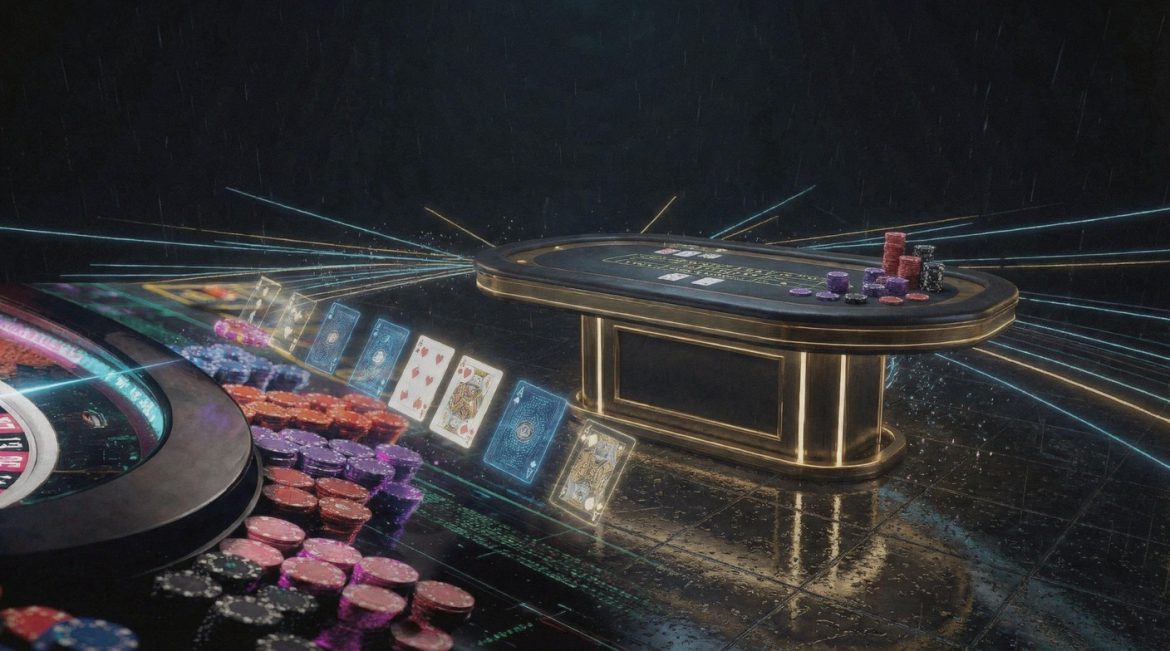
As a lead infrastructure architect for several high-volume digital gambling platforms, I have spent the last decade obsessing over milliseconds. The year 2026 has arrived, and with it, the expectations of the modern player have transcended the capabilities of legacy internet protocols. In the early days of mobile wagering, a one-second delay was annoying but tolerable. Today, that same delay is a catastrophic failure of service. For the largest and most successful Canadian casinos, the transition to dedicated 5G server environments is no longer a luxury, it is the fundamental bedrock of operational survival. We are no longer just transmitting video; we are managing complex, real-time data streams that include volumetric video, biometric security checks, and instant blockchain settlements. Without a dedicated 5G slice of the network, the promise of a truly immersive live experience remains a buffering nightmare. I want to walk you through the technical necessity of this shift and explain why the vast geography of Canada demands a specialized approach to connectivity.
The Millisecond War: Latency vs. Integrity
In 2026, the integrity of a live game depends entirely on the synchronization of the server and the client. When a player in a remote part of British Columbia places a high-stakes bet on a live wheel located in a studio in Toronto, the round-trip time for that data packet determines the fairness of the game.
The Problem with Shared Bandwidth
Standard 4G and even early-stage 5G networks are shared environments. When thousands of people in a metropolitan area start streaming a high-definition hockey game, the network becomes congested. For a gambler, this congestion manifests as “jitter” or “lag.” If the player’s bet reaches our server after the “no more bets” signal is triggered by the physical wheel, but the player’s screen still shows the betting window is open, we have a dispute. A dedicated 5G server eliminates this conflict by providing a private, unhindered lane for gambling data. By utilizing network slicing technology, we can carve out a specific portion of the 5G spectrum that is reserved exclusively for our gaming traffic, ensuring that the latency never exceeds 5 milliseconds, regardless of what else is happening on the public network.
Real-Time AI and Fraud Detection
The speed of 5G is not just for the player’s enjoyment; it is for our security. In 2026, we utilize real-time AI to analyze betting patterns and detect potential bot activity or card counting in live environments. This analysis happens in the cloud and needs to be fed back to the table in a split second. If the server is slow, the fraud detection is useless. A dedicated high-speed link allows our AI to scan every frame of the live broadcast and every move of the digital chips, comparing them against millions of historical data points to ensure the game remains clean and fair for everyone involved.
Edge Computing and the Canadian Geographical Challenge
Canada presents a unique problem for live gaming providers. The sheer distance between major cities creates a natural latency problem caused by the speed of light in fiber optics. To solve this, we are moving the servers closer to the players.
Localized MEC (Multi-access Edge Computing)
By deploying 5G servers at the “edge” of the network, specifically in localized Canadian hubs, we reduce the physical distance data must travel. Instead of a player in Calgary connecting to a central server in Montreal, they connect to a 5G edge node located in Alberta. This node processes the immediate game logic and only sends the final results to the central database. This decentralized architecture is the only way to provide a consistent 8K video feed that does not freeze. The 5G server acts as the local brain, handling the heavy lifting of the visual rendering and the real-time interaction, providing a seamless experience that feels as if the dealer is sitting in the same room as the player.
Stability in Extreme Environments
Canadian weather is notoriously hard on physical infrastructure. 5G technology, especially in the millimeter-wave spectrum, was initially prone to interference from heavy snow or rain. However, by 2026, our dedicated server environments use sophisticated beamforming technology. This allows the signal to “wrap around” obstacles and maintain a stable connection even during a prairie blizzard. For our players, this means the game does not stop just because the weather is bad. The reliability of 5G is what allows us to offer twenty-four-hour live play with 99.99 percent uptime, a metric that was impossible with older wireless standards.
8K Streaming and the Volumetric Future
The games we are producing in 2026 are no longer flat, two-dimensional videos. We have entered the era of volumetric gaming, where players can view the table from any angle using AR glasses or high-end mobile devices.
Bandwidth Demands of Immersive Play
A standard 1080p stream requires about 5 Mbps of stable bandwidth. An 8K volumetric stream, which captures the depth and texture of the cards and the wheel, requires upwards of 100 Mbps per user. If a platform has ten thousand players active at once, the bandwidth requirements are astronomical. Dedicated 5G servers are the only infrastructure capable of handling these loads without collapsing. This high-capacity throughput allows us to offer features like “zoom-in” on the cards, where the player can see the microscopic texture of the paper to verify authenticity, providing a level of transparency that was previously restricted to physical environments.
Low Power Consumption for Mobile Users
An often overlooked benefit of the 5G server architecture is what it does for the player’s device. Because the 5G network is more efficient at handling data packets, the mobile device’s antenna does not have to work as hard to maintain a connection. This extends the battery life of the player’s smartphone or tablet. In 2026, we want our players to be able to enjoy a long session without worrying about their phone dying. The server-side optimizations we perform over 5G allow us to offload much of the processing power from the player’s phone to our edge servers, making high-end gaming accessible even on mid-range devices.
Financial Reliability and Instant Payouts
In the modern gaming world, the game is only half the experience. The other half is the movement of money. Canadian players in 2026 expect their winnings to be available the moment the ball stops spinning.
| Feature | Legacy 4G/Wi-Fi | Dedicated 5G Server (2026) |
| Average Latency | 50 to 100 ms | 1 to 5 ms |
| Video Resolution | 1080p (Buffered) | 8K Volumetric (Instant) |
| Payout Verification | 30 to 60 seconds | Real-time Blockchain Sync |
| Concurrent Users | Limited by node | Massive (via Network Slicing) |
| Connection Stability | High interference | Beamforming Resilience |
Blockchain Verification and Network Speed
The integration of decentralized finance into the gaming world requires constant communication with the blockchain. Every win must be verified, and the transaction hash must be broadcast to the network. This process is sensitive to time-outs. A dedicated 5G connection ensures that the handshake between our gaming server and the blockchain nodes happens without interruption. This is how we facilitate instant payouts to digital wallets. If the connection drops during the verification process, it can lead to “stuck” transactions, which are a primary source of frustration for high-stakes players.
Network Slicing for VIP Tiers
We even use 5G network slicing to offer tiered service levels. Our VIP players, who are wagering significant amounts, are placed on a “Platinum Slice.” This is a dedicated, high-priority data lane that is guarded against any form of congestion. It is essentially a private digital tunnel from the player’s home in Ontario directly to our game engine. This ensures that their experience is never compromised, providing the level of white-glove service that high-net-worth individuals expect in the digital age.
Frequently Asked Questions
What is the primary difference between a public 5G signal and a dedicated server slice?
A public signal is shared among all users, from people checking emails to those watching 4K movies. A dedicated slice is a logically separated portion of the network that is reserved only for specific traffic. For gaming, this means your betting data never has to compete with someone else’s Netflix stream, resulting in zero lag and a more stable connection.
Why is latency more important for live dealer games than for standard slots?
In a standard slot game, the result is determined by a random number generator on the server, and the animation follows. In a live dealer environment, the result happens in the physical world. If there is a delay in the video or the data transmission, the player is essentially seeing the past. 5G reduces this delay so the player sees the action in true real-time.
How does 5G technology improve the security of my personal data?
5G introduces more advanced encryption standards than its predecessors. By using a dedicated server environment, we can implement end-to-end hardware-level encryption that is much harder to intercept than traditional Wi-Fi or 4G signals. It creates a secure, private corridor for your financial and personal information.
Will I need to buy a new phone to experience these 2026 gaming standards?
Most flagship devices released since 2024 are fully 5G-capable. However, to take advantage of the 8K volumetric streams and network slicing we offer in 2026, you will need a device that supports the latest 5G Standalone (SA) architecture, which most Canadian providers have now fully deployed.
Can 5G servers really work in remote parts of the Canadian North?
Through the use of low-earth orbit satellites like Starlink, which now integrate with 5G ground stations, we can provide high-speed, low-latency access even in remote territories. The 5G server acts as the local distribution point, bringing the high-speed experience to areas that previously had no reliable internet.
Does 5G use more data than my current home Wi-Fi?
5G itself doesn’t use more data, but the high-quality content it enables, like 8K video, does. A ten-minute session in 2026 can consume significantly more data than it did in 2020 because the visual fidelity is so much higher. We recommend players use unlimited 5G data plans for the best experience.
What is “Beamforming” and how does it help my gaming session?
Beamforming is a 5G technique that focuses a wireless signal in a specific direction toward a single user, rather than broadcasting it in all directions. This creates a stronger, more reliable connection for your device, reducing the chance of a disconnect if you move around your house or travel in a vehicle.
How does the casino benefit from these massive infrastructure investments?
Our benefit is twofold, higher player retention and lower operational risk. Players stay longer when the experience is flawless. Furthermore, by reducing lag-related disputes and improving fraud detection through 5G, we save millions of dollars in administrative and security costs every year.
Is 5G safe for long-term use during extended gaming sessions?
5G technology operates within strict international safety guidelines regarding radiofrequency exposure. In fact, because 5G is more efficient and transmits data in shorter bursts, the overall exposure can often be lower than older technologies that required constant, high-power searching for a signal.
How will 5G evolve into 6G for the gaming industry by 2030?
While we are currently maximizing 5G, 6G is already in development. It will likely introduce even higher frequencies and the integration of haptic feedback, allowing players to “feel” the cards or the wheel through their devices. The 5G servers we are building today are the necessary foundation for that future haptic world.
Conclusion
The transition to dedicated 5G server environments is the most significant technological leap the Canadian gaming industry has ever taken. We have moved past the era of “best-effort” connectivity and entered an age of guaranteed performance. For the operator, it means the ability to host thousands of high-fidelity, volumetric games without the fear of a system crash or a latency dispute. For the player, it means that the digital wall between the home and the gaming floor has finally crumbled. The speed, reliability, and security of 5G have created a new standard where the only thing that matters is the spin of the wheel or the flip of the card, exactly as it happens in the physical world.
As we look deeper into 2026, the platforms that have failed to invest in this dedicated infrastructure are already fading away. Players are savvy, they know when they are being given a subpar, lagging experience, and they will not tolerate it. In a country as vast as Canada, 5G is the thread that ties the player to the action, regardless of distance or weather. By mastering this technology, we have not only future-proofed our operations but also respected the time and the passion of the Canadian player. The future is fast, it is dedicated, and it is powered by the invisible, lightning-quick waves of the 5G revolution.